

By RestSage Team · Updated November 7, 2026 · 11 min read · How we review
What's the best pillow for back sleepers? One that fills the small space under your neck and keeps your head from tipping forward or back. For most people that means a medium-height, medium-firm pillow; your build and your mattress decide where you land in that range. This guide is based on research: we read the Sleep Foundation's back sleeping and pillow pages and Consumer Reports' buying guide. We haven't slept on any pillow mentioned here, and we don't rank brands. One pillow we mention has a research review on RestSage, and we earn a commission if you buy it through that review, at no extra cost to you. Last checked: November 2, 2026.
Quick answer
The best pillow for back sleepers is usually medium loft, 3 to 5 inches thick, and medium-firm. It should support the curve of your neck without pushing your chin toward your chest. Too tall bends your head forward; too flat lets it tip back. Test the height with the chin check below, and if your lower back feels strained, add a thin pillow under your knees.
The short version, in four checks:
- Your chin points at the ceiling, not down at your chest.
- The back of your neck rests on the pillow, with no open space under it.
- Your shoulders lie flat on the mattress, not on the pillow.
- The pillow keeps its height after a few minutes.
What a back sleeper's pillow has to do
On your back, there's a small space between your neck and the mattress. That's the gap your pillow fills. It's smaller than a side sleeper's gap, because no shoulder lifts your head off the bed.
The Sleep Foundation's guide to sleeping positions (updated July 25, 2025, medically reviewed by Abhinav Singh, MD) puts it in one line: "Use a pillow that supports the natural curve of your neck without being excessively high." Its guide on how to sleep on your back (updated October 23, 2025) describes the goal as "keeping the head and neck in a neutral position."
So the pillow has two jobs: hold up the curve behind your neck, and not lift your head so high that your chin moves forward. A pillow built for side sleeping usually fails the second one. Consumer Reports' buying guide (updated January 13, 2026) says: "If you're a back sleeper, you may need a flatter pillow than what a side sleeper needs."
How high: your spot in the 3 to 5 inch range
The Sleep Foundation's back sleeper pillow guide (updated October 20, 2026) says back sleepers "tend to prefer medium-loft pillows, which are those that measure between 3 and 5 inches thick." Two inches is a big range when it sits under your head all night.
Three things move you up or down inside it:
- Your mattress. On a soft bed your body sinks, so your head needs less lift. Consumer Reports: "If you have a firmer mattress, you want a fuller pillow."
- Your build. A rounder upper back or broader chest lifts your head a little more off the mattress. A slim, flat back needs less.
- How the pillow compresses. A soft 5-inch pillow may compress to 3 inches under your head. A 4-inch foam pillow stays near 4. Judge the height you get while lying on it, not the number on the box.
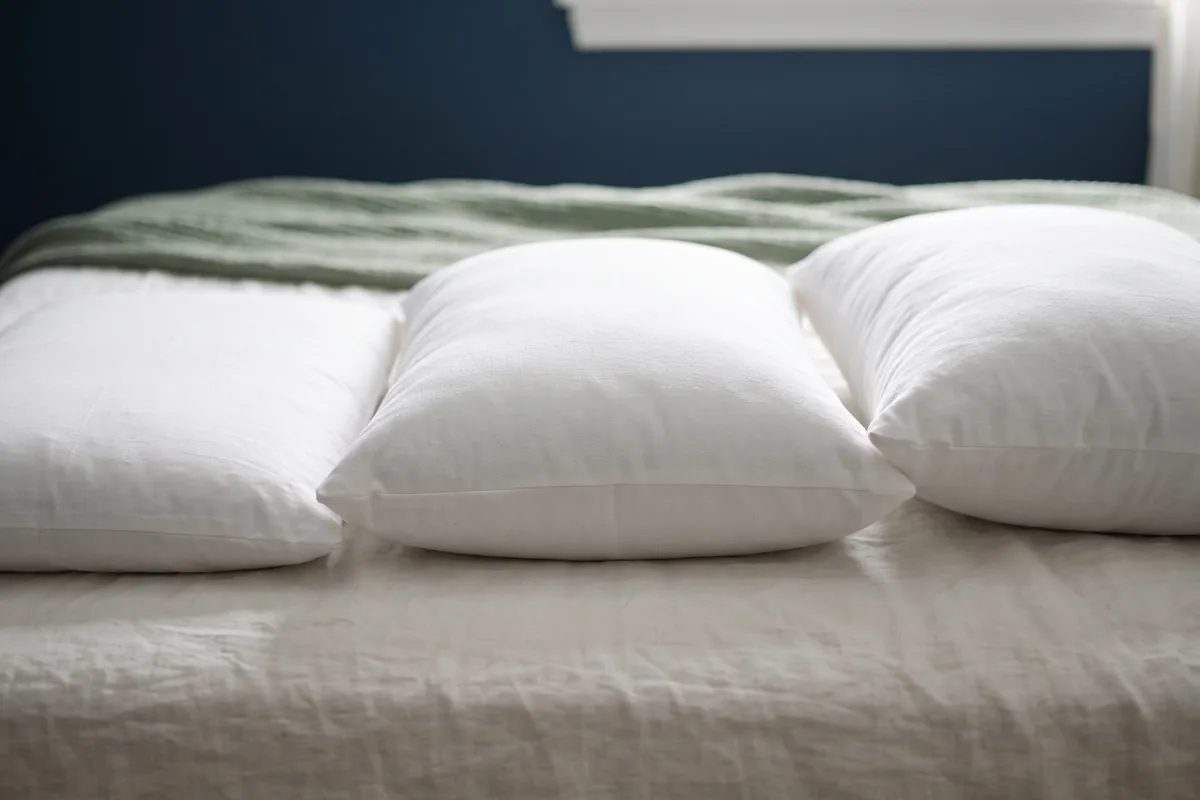
If your partner sleeps on their side, don't buy the same pillow for both of you: theirs fills a wider gap. Our guide on how to choose a pillow has the height bands for every position.
The chin check: too high, too low or right
You don't need a tape measure, just a phone camera and someone to hold it. Lie on your back on your own bed, the way you sleep. Have them take a photo from the side, at mattress level, and look at where your chin points.
| What the photo shows | What it usually means |
|---|---|
| Chin tucked toward your chest | Pillow too tall or too firm |
| Chin tipped up, head leaning back | Pillow too flat or too soft |
| Open space under the back of your neck | Pillow too flat at the edge, or placed too high up |
| Shoulders resting on the pillow | Pillow pulled down too far |
| Chin at the ceiling, neck supported | About right |
The Sleep Foundation's back sleeping guide says the right pillow keeps the head from tilting too far forward or backward. A photo shows that far better than you can feel it.
Take a second photo after five minutes. Soft fills and memory foam both settle, and the second photo is the one that counts.

Firmness: why medium-firm keeps coming up
Height and firmness are separate. A pillow can be tall and soft, or thin and firm. For back sleepers, the pillow has to reach the right height and then stay there.
The Sleep Foundation's back sleeper guide says "most back sleepers prefer medium-firm pillows." Its shopping guide (updated May 22, 2023) says back sleepers "typically do well with medium-loft pillows that are somewhat firm."
- Too soft: your head sinks into the middle, the edges puff up around your ears and the support under your neck collapses.
- Too firm: the pillow keeps its full height all night, so if it's even slightly tall, your chin stays pushed forward.
A firm pillow can be fine when the height is right. If a new foam pillow feels hard, give it a week; our guide to a memory foam pillow that's too firm explains how to tell break-in from a bad fit.
Shape: rectangle, contour or one with a dip
The Sleep Foundation's back sleeper guide notes that "most bed pillows are rectangular, though their loft and shape can vary." For many back sleepers, a rectangle of the right height and firmness is enough.
Shaped pillows add one thing a rectangle can't: one height for the neck and another for the head.
- Contour pillows have a raised edge and a lower area. On your back, the raised edge goes under your neck curve.
- Pillows with a center dip cradle the back of the head. The Sleep Foundation's sleeping positions guide mentions "a relatively low-loft pillow or a pillow with a divot" as a way to keep the neck neutral on your back.
- Adjustable pillows let you remove fill until the chin check comes out right.
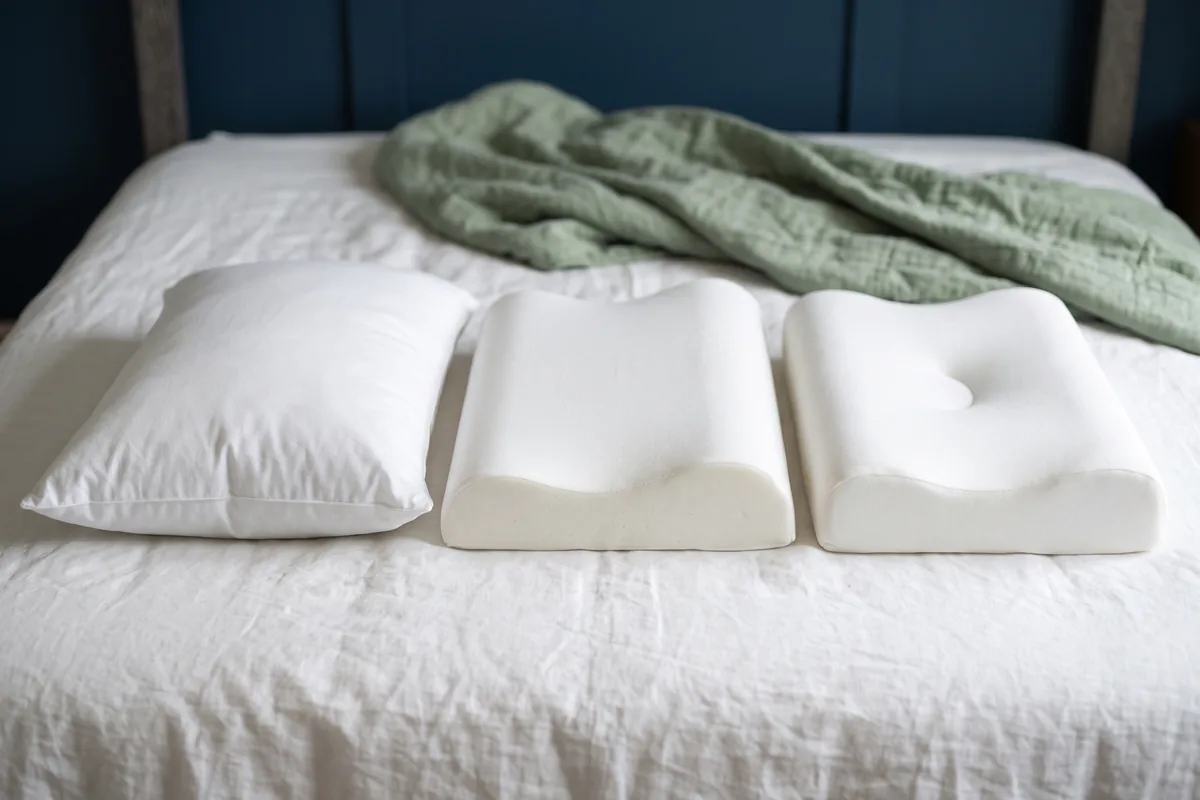
The catch: a molded pillow's height is fixed. If the neck edge is taller than your neck curve, you can't fluff it lower. Check the height in inches and the return rule before you buy.
One example is the Derila Ergo, a firm contour memory foam pillow. The seller lists it at 4.7 inches, and its FAQ says "back sleepers typically benefit from the thinner contour side" (product page, read November 2, 2026). The seller doesn't say which edge the 4.7 inches refers to, so try the lower edge first and do the chin check. Our Derila Ergo research review covers the price, the return rules and the firmness complaints buyers mention.
Which fill works on your back
The Sleep Foundation's back sleeper guide says "there is no single material type that works best for back sleepers overall." What matters is how each fill behaves under your head, face up.
| Fill | On your back | Watch for |
|---|---|---|
| Solid memory foam | Holds a steady height | Can feel firm and warm; check the height first |
| Shredded memory foam | Fill can be removed to lower it | Shifts during the night |
| Latex | Springy, keeps its shape | Usually costs more, often tall |
| Down alternative or polyester | Soft, easy to shape | Can flatten under the head by morning |
| Down and feather | Soft and squashy | May not keep the neck supported |
| Buckwheat hulls | Firm, can be pushed into the neck curve | Heavy and noisy when you move |
If you like soft pillows, pick a fuller one so it still has height after it compresses. If you like foam, pay more attention to the listed height, since foam won't flatten to fit you. If you sleep warm, Consumer Reports notes that "pillows made with shredded foam or polyester tend to stay cooler than those made of solid foam."
The second pillow: under your knees
Lying flat with straight legs, some people feel their lower back arch away from the mattress. The Sleep Foundation's sleeping positions guide says "a small gap can form between your lower back and the mattress surface, leading to tension in the lower back." Its how-to guide says "it may help to place a supportive pillow under your knees before bed," with the knees slightly bent.

- Start thin. A folded blanket is enough to test. The same guide warns that if a lower-back pillow "is too large or thick, however, it may create even more discomfort."
- Recheck your head pillow after. Bent knees can shift how your upper back sits. Do the chin check again.
- This is comfort, not treatment. If your back hurts most mornings no matter what you change, ask a doctor.
Shoulders, arms and the mattress
Shoulders flat, pillow above them. The Sleep Foundation says that on your back "your shoulders should lie flat." Pulled down under your shoulders, the pillow lifts your upper back and pushes your head forward. Its bottom edge belongs at the top of your shoulders.
Arms in the same spot. The same guide suggests keeping your arms "in the same position to reduce asymmetrical strain on your neck muscles."
The bed underneath. The back sleeper guide says "most back sleepers prefer a medium-firm mattress." If yours sags in the middle, your hips sink and your head ends up high, which can make a good pillow feel tall.

If you roll onto your side too, a back-sleeper pillow may feel low there. Our side sleeper pillow guide shows how much more height your side needs.
How to test a new pillow at home
- Read the return rule before you open it. Some stores only take back sealed pillows, and vacuum-packed foam can't be resealed. For a Derila pillow, our Derila return policy guide covers the store and ClickBank rules.
- Do the chin check on night one, with a photo after five minutes.
- Give it about a week, with a one-line note each morning.
- Change one thing at a time. Swap the head pillow and add a knee pillow on the same night, and you won't know which one helped.
Common mistakes
- Using a side sleeper's pillow on your back. It's usually too tall and pushes the chin forward.
- Going flat to "keep the spine straight." Too little height leaves the neck unsupported.
- Judging height by the label. Check it while you lie on it, after five minutes.
- Pulling the pillow under your shoulders. It belongs under your head and neck.
- Using a contour pillow backward. The raised edge goes under the neck.
- Stacking a thick pillow under your knees. Start thin.
Key takeaways
- Most back sleepers do best with a medium-loft pillow, 3 to 5 inches thick, per the Sleep Foundation.
- Medium-firm is the most common preference, so the pillow keeps its height all night.
- The chin check is the simplest test: chin to the ceiling, neck supported, shoulders flat.
- A soft mattress calls for less height; a firm one for a bit more.
- Contour and dipped shapes suit some back sleepers, but their height is fixed.
- A thin pillow under the knees may help with lower-back tension.
Related guides
- How to choose a pillow: height bands for every position, plus firmness and fill.
- Side sleeper pillow guide: what changes when you turn onto your side.
- Derila Ergo research review: a firm contour pillow, with price and returns checked.
- Memory foam pillow too firm?: break-in time and when to give up.
- Derila return policy: the rules for an opened pillow.
Sources we checked
All pages opened on November 2, 2026.
- Sleep Foundation, "Best Pillows for Back Sleepers", by Logan Foley, updated October 20, 2026: medium loft, medium-firm, materials, mattress firmness.
- Sleep Foundation, "What Is the Best Sleeping Position?", medically reviewed by Abhinav Singh, MD, updated July 25, 2025: neck curve, shoulders, arms, lower-back gap.
- Sleep Foundation, "How to Sleep on Your Back", medically reviewed by Gerard Meskill, MD, updated October 23, 2025: neutral head position, knee pillow.
- Sleep Foundation, "How to Shop for Pillows", updated May 22, 2023: "somewhat firm" for back sleepers.
- Consumer Reports, "Pillow Buying Guide", updated January 13, 2026: flatter pillows for back sleepers, mattress firmness, cooler fills.
- Derila Ergo product page: the seller's height and FAQ line on back sleepers.
Frequently asked questions
What kind of pillow is best for back sleepers?
Usually a medium-loft pillow, 3 to 5 inches thick, with a medium-firm feel. The Sleep Foundation says "most back sleepers prefer medium-firm pillows." It can be a rectangle, a contour or a pillow with a center dip, as long as the height fits you.
Should back sleepers use a flat pillow?
Flatter than a side sleeper's, yes. Flat, no. Consumer Reports says back sleepers "may need a flatter pillow than what a side sleeper needs," but too little height lets your head tip back.
How thick should a pillow be for a back sleeper?
Between 3 and 5 inches, per the Sleep Foundation. Go lower on a soft mattress or with a slim build, higher on a firm mattress. Check the height while lying on it, since many fills compress.
Are contour pillows good for back sleepers?
They can be, if the raised edge matches your neck curve. On your back, the higher edge goes under your neck and your head rests in the lower area. Check the seller's measurements and return rules first, since the height is fixed.
Should back sleepers put a pillow under their knees?
It's optional. The Sleep Foundation says "it may help to place a supportive pillow under your knees before bed" to ease tension in the lower back. Start with something thin.
Should my shoulders be on the pillow when I sleep on my back?
No. The Sleep Foundation says your shoulders "should lie flat." The pillow holds your head and neck, with its bottom edge at the top of your shoulders.
Is sleeping on your back bad if you snore?
It can make snoring worse for some people. The Sleep Foundation says back sleeping can make snoring and acid reflux worse for some people, and it doesn't recommend it during pregnancy. A pillow won't fix snoring. If you snore loudly, feel sleepy during the day or someone notices pauses in your breathing, see a doctor.
How long does it take to get used to a new pillow?
Give it about a week, especially with firm foam. Keep a one-line note each morning, and read the return rule before you open the pillow so you know how long you have to decide.
Next step
Tonight, lie on your back on your own bed and ask someone to take a side photo after five minutes. If your chin points toward your chest or tips back, use our guide on how to choose a pillow to narrow down the height before you buy.
General information, not medical advice. Comfort varies from person to person; if you have ongoing pain, numbness or breathing problems during sleep, talk to a doctor.