

By RestSage Team · Updated November 4, 2026 · 14 min read · How we review
What's the best pillow for side sleepers? The one that fills the gap between your head and the mattress, and that gap is different for every body and every bed. This guide is research: we read the Sleep Foundation's side sleeping pages, Consumer Reports' pillow buying guide and the product page of one contour pillow seller. RestSage earns a commission if you buy that seller's pillow through our review, at no extra cost to you. It doesn't change what we write here. We haven't slept on any of the pillows mentioned here, and we don't rank brands. Last checked: November 1, 2026.
Quick answer
The best pillow for side sleepers fills the gap your shoulder creates and keeps your head level. That gap grows on a firm mattress and with broad shoulders, and shrinks on a soft bed. Keep your shoulder on the mattress, just below the pillow's edge. If you fold your pillow or sleep with an arm under it, it's too low.
The short version, in four checks:
- Your shoulder sits on the mattress, not on the pillow.
- Your head doesn't tilt up toward the ceiling or down toward the bed.
- You don't need to fold, stack or prop the pillow with your arm.
- The pillow still works when you turn to your other side.
The gap at your shoulder, explained
Lie on your side and your shoulder lifts your upper body off the mattress. Unless something fills it, there's open space between your head and the bed. That space is the gap, and the pillow's whole job is to fill it.
The Sleep Foundation's side sleeping guide (updated September 26, 2025) puts it in one line: "Ideally, the pillow should fill in the space between your head and the mattress." Too little pillow and your head drops toward the bed. Too much and it tips up.
Three things set the size of your gap:
- Your shoulders. Wider shoulders lift your head higher.
- Your mattress. The more your shoulder sinks in, the smaller the gap.
- Your weight. A heavier body sinks deeper into both the mattress and the pillow.
That's why two people with the same pillow can have very different nights. The rest of this guide goes through each of those three, then the habits that show a pillow isn't filling the gap. To turn your gap into a pillow height, see the loft bands in our guide on how to choose a pillow; we don't repeat them here.
Your mattress changes the gap
A pillow that feels perfect in a hotel can feel wrong at home, and the bed is often the reason. On a soft mattress, your shoulder sinks in and your head ends up closer to the bed. On a firm one, your shoulder stays on top and your head sits higher.
Consumer Reports' buying guide (updated January 13, 2026) says it plainly: "If you have a firmer mattress, you want a fuller pillow. If you have a softer mattress, you want a thinner pillow."
What that means in practice:
- New mattress, old pillow. If you switched to a softer bed or added a plush topper, your old pillow may suddenly feel too tall.
- Firm bed, flat pillow. A firm mattress keeps your shoulder high, so a thin pillow leaves a bigger gap than you'd expect.
- A mattress that dips. Where an older mattress sags under your shoulder, the gap changes again. The Sleep Foundation's side sleeper pillow guide (updated October 20, 2026) notes that "many side sleepers feel pressure in the shoulders and hips because their mattress is not supportive enough."

The Sleep Foundation's side sleeping guide says "the best mattresses for side sleepers tend to be medium or medium firm." You don't need a new mattress to use this guide. You just need to test any pillow on the bed you actually sleep on, not on a store shelf or a firm sofa.
If you're buying a mattress and a pillow at the same time, settle the mattress first. The pillow is the easier piece to change.
Where your shoulder goes: below the pillow's edge
Filling the gap is only half of it. Placement matters just as much. A pillow can be the right height and still leave a gap if it sits in the wrong spot.
For side sleeping, the pillow holds your head and neck. Your lower shoulder stays on the mattress, tucked just under the pillow's bottom edge. If your shoulder climbs onto the pillow, the pillow is no longer under your neck, and your neck ends up hanging over an empty space.
Try this setup tonight:
- Lie on your side with your shoulder flat on the mattress.
- Pull the pillow down until its bottom edge touches the top of your shoulder.
- Check that your neck rests on the pillow, not over an empty space.
- Let your arms rest in front of you. The Sleep Foundation suggests keeping them "either by your sides or slightly in front of you."
If you have to push the pillow away from your shoulder to get comfortable, it's probably too tall. If you keep pulling it down and your head still drops, it's too low.

Arm under the pillow? What that habit tells you
Many side sleepers wake up with an arm shoved under the pillow. It feels like a quirk, but it's often a clue about fit.
Here's the logic: your arm adds height. When you slide it under the pillow, you raise your head. If you do that every night, your body may be making up for a pillow that leaves the gap partly empty.

Two quick checks:
- Try a slightly taller or fuller pillow for a few nights. If the arm habit fades, height was the issue.
- Notice which side it happens on. If it's only one side, your pillow may be flatter on that end, or your mattress may dip there.
Some shaped pillows are built around this habit, with a lower area or a cut-out for the arm. More on those in the section on shapes below.
One caution: an arm under your head all night can go numb or tingle. A pillow is a comfort product, not a fix for that. If numbness keeps coming back, talk to a doctor.
Signs your pillow isn't filling the gap (no tape measure needed)
You don't need to measure anything to spot a pillow that's the wrong size for you. Watch what you do with it.
| What you notice | What it usually means |
|---|---|
| You fold the pillow in half before you fall asleep | Too low for your gap |
| You stack a second pillow on top | Too low for your gap |
| You wake up with an arm or hand under the pillow | Too low, or too soft to hold your head up |
| Your head tilts down toward the mattress | Too low or too soft |
| Your head tilts up toward the ceiling | Too tall, or your mattress is softer than the pillow expects |
| The pillow slides away from your shoulder during the night | Too tall, or too bulky to stay put |
| Your shoulder ends up on the pillow by morning | The pillow is pulled down too far, or it's too big for you |
Ask a partner to glance at you while you lie on your side, or take a photo from behind. A head that tilts clearly up or down is easier to see from outside than to feel.
These signs are about the wrong size. A pillow can also start out fine and then flatten with age. If yours used to work and now you're folding it, it may simply be worn out. Our guide to choosing a pillow covers how long each fill tends to last.
Folding it in half or stacking two: what that workaround tells you
Folding and stacking are the two most common home fixes, and both tell you the same thing: you need more height than your pillow gives.
Folding in half doubles the height at the center but makes the pillow narrow and lumpy. It tends to unfold or shift as you move. As a test, it's useful. As a long-term setup, it rarely stays put.
Stacking two pillows gives more height but two loose layers. They can slide apart, and the top one may tilt. If you stack, put the firmer pillow on the bottom and the softer one on top, so the base doesn't collapse.

What to do with the result:
- If one folded pillow feels right, look for a single pillow about that height, or one with adjustable fill.
- If two stacked pillows feel right, a taller pillow is the cleaner answer.
- If neither helps, the issue may be firmness, not height. A soft pillow can squash flat under your head no matter how much of it you use.
Four ways a pillow fills the shoulder gap
Lists of "best side sleeper pillow" picks are usually sorted by category: best latex, best cooling, best value. It's more useful to sort them by how they fill the gap. There are four main approaches.
1. Height alone. A plain rectangular pillow with enough loft, often with a gusset, a strip of fabric around the sides that keeps the pillow from thinning at the edges. It works if you know your height and stay mostly on your side. It's the simplest option and fits any pillowcase.
2. A cut-out or U-shape for the shoulder. The Sleep Foundation's side sleeper guide notes that some foam pillows "have cut-outs to accommodate and support your shoulders and neck." A U-shape or notch lets the shoulder slide in under the pillow, so the pillow can sit closer without riding on top of it.
3. A contour with raised edges. A shaped foam pillow with a higher edge for the neck and a dip for the head. The height is fixed by the shape, so it suits you only if that height matches your gap. One example is the Derila Ergo, which the seller describes as an "Ergonomic Butterfly Design" with a shoulder and an arm support area. Its FAQ says "side sleepers often prefer the higher contour end," though the same page also calls it "designed for back and stomach sleepers" (seller's product page, read November 1, 2026). It lists a fixed size of 21.3 x 14.2 x 4.7 inches. Our Derila Ergo research review covers who it suits, the price and the return rules (RestSage earns a commission if you buy through that review).
4. Adjustable fill. A pillow with shredded foam or loose fill you can add or remove through a zipper. It's the most forgiving choice if you're not sure of your height. The Sleep Foundation's side sleeper guide warns that "adjusting the pillow's loft will also affect its firmness," so taking fill out also makes it softer.
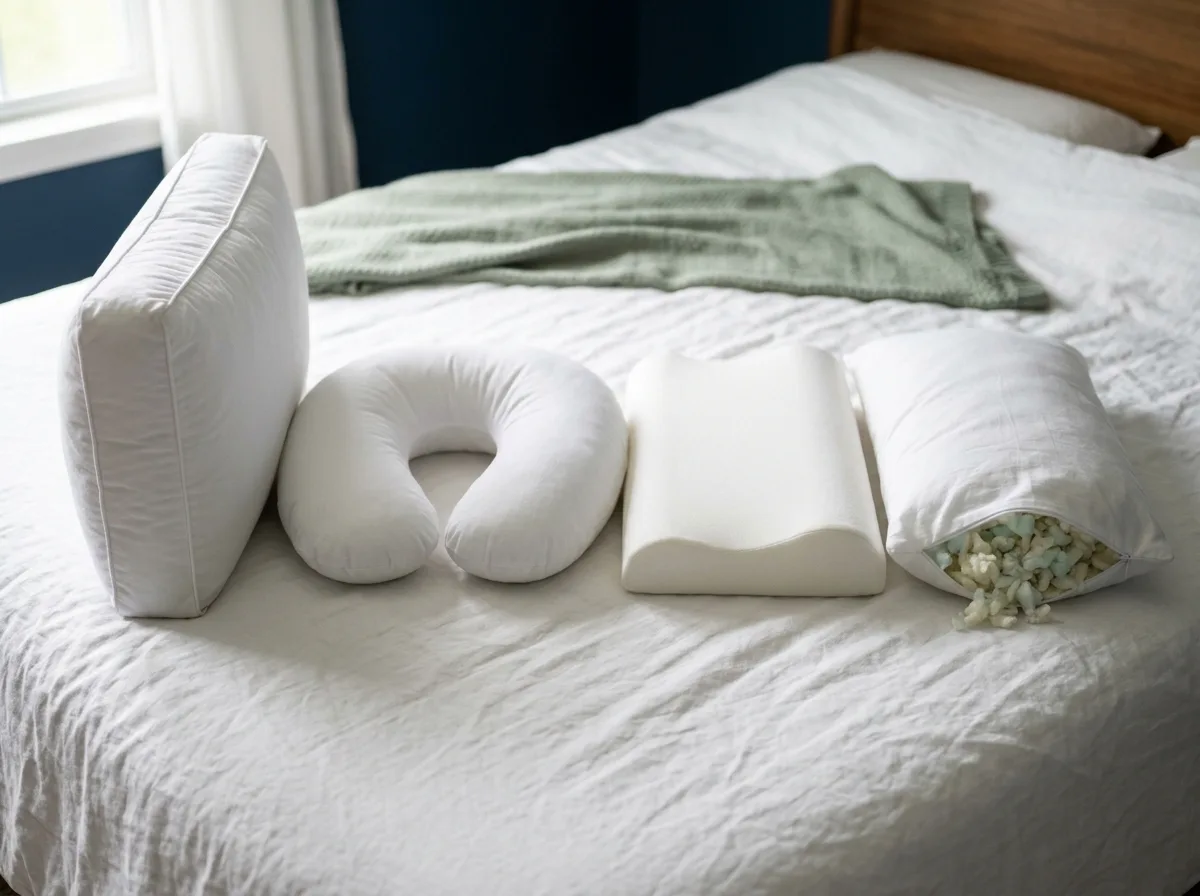
Shaped pillows have one more catch: you have to lie on them the way they're designed. If the higher edge ends up under your head instead of your neck, the pillow can feel wrong even when the height is right. If a new foam pillow feels hard in the first nights, our guide to a memory foam pillow that's too firm explains how to tell break-in from a bad fit.
Switching sides at night: does your pillow work both ways?
Most side sleepers don't stay on one side. The Sleep Foundation's side sleeper pillow guide says "shifting from side to side, back to front, during sleep is typical."
For a rectangular pillow, turning over is easy. The pillow is the same on both ends, so your gap is filled whichever way you face. The only question is whether you can turn without fighting a pillow that's too bulky.
Shaped pillows need a closer look:
- Is it symmetrical? A pillow with the same edge on both sides works facing left or right.
- Is the cut-out on one side only? Then it suits one direction, and you'll need to turn the pillow when you turn.
- Is it heavy or slow to reshape? Firm foam can be awkward to move at 3 a.m.
As for which side is better, the Sleep Foundation's side sleeping guide says "for most people, there's no significant difference between right-side sleeping versus left-side sleeping." So the goal is a pillow that works on both, not one that trains you to stay on one.
Broad shoulders, narrow frame or a heavier build
The pillow everyone raves about suits someone's body. It may not suit yours.
Broad shoulders create a taller gap. The Sleep Foundation's side sleeper guide says people with broad shoulders "may need a pillow that is over 6 inches." Our pillow-choosing guide has the full height bands.
A narrow frame creates a smaller gap. A tall pillow made for an average adult can tip a petite sleeper's head up. If most pillows feel too high, a medium or adjustable one is the safer bet.
A heavier build sinks deeper into both the mattress and the pillow. The same Sleep Foundation guide notes, in one of its picks, that "people in higher weight categories may find their heads sink too deeply" into that pillow. That points to a firmer or denser pillow that keeps its height under more weight. A soft, fluffy one may flatten by midnight.

These three overlap. A broad-shouldered, heavier sleeper on a soft mattress may land in the middle: the shoulder needs height, but the bed takes some of it back. That's why testing on your own bed matters more than any chart.
How many nights before you decide
A new pillow always feels strange on night one. Give it about a week before you judge it, and jot down one line each morning: how it felt, which side you woke on, and whether you folded it or used your arm.

Check the return rule before you open the bag. Some stores take back used pillows; others only take sealed ones. If you're looking at a Derila pillow, our Derila return policy guide covers its store and ClickBank rules line by line.
Common mistakes
- Testing a pillow on the wrong surface. A store shelf or a firm sofa isn't your mattress. Judge it on your own bed.
- Letting your shoulder ride up on the pillow. Keep the shoulder on the mattress, just below the edge.
- Ignoring the arm habit. An arm under the pillow every night usually means the pillow is too low.
- Living with a folded pillow. It's a useful test, not a long-term setup.
- Buying for someone else's body. A pillow picked for average shoulders may not fit broad or narrow ones.
- Forgetting the mattress. A new soft mattress or topper can make your old pillow too tall.
- Using a shaped pillow backward. Check which edge goes under your neck.
Key takeaways
- A side sleeper pillow fills the gap between your head and the mattress, so your head stays level.
- Shoulders, mattress and body weight set the size of that gap.
- Consumer Reports: a firmer mattress calls for a fuller pillow, a softer one for a thinner pillow.
- Your shoulder goes on the mattress, just below the pillow's edge.
- Folding, stacking or an arm under the pillow usually means it's too low.
- Height, a cut-out, a contour or adjustable fill: four ways to fill the gap. Pick the one that matches your body and how often you turn.
Related guides
- How to choose a pillow: height bands in inches, plus firmness and fill.
- Derila Ergo research review: a firm contour pillow, with the price and returns checked.
- Memory foam pillow too firm?: break-in time, smell and when to give up.
- Derila return policy: the store and ClickBank rules for an opened pillow.
Sources we checked
All pages opened on November 1, 2026.
- Sleep Foundation, "Best Pillows for Side Sleepers", by Jeremy Klein, medically reviewed by Jenny Iyo, DPT, updated October 20, 2026: broad shoulders, mattress support, cut-outs, switching sides, heavier sleepers, adjustable loft.
- Sleep Foundation, "Side Sleeping", by Danielle Pacheco, medically reviewed by Brandon R. Peters, MD, updated September 26, 2025: filling the space under the head, arm position, knees, left vs right side, mattress firmness.
- Consumer Reports, "Pillow Buying Guide", updated January 13, 2026: mattress firmness and pillow fullness, trying a pillow at home, trial periods.
- Derila Ergo product page: the seller's shape name, size and FAQ on side sleepers.
Frequently asked questions
What type of pillow is best for side sleepers?
One that fills the gap between your head and the mattress and keeps that height all night. That can be a tall rectangular pillow, a pillow with a shoulder cut-out, a contour pillow or one with adjustable fill. The Sleep Foundation says "most side sleepers need medium to high loft pillows."
Should side sleepers use a soft or firm pillow?
Usually something in the middle. The Sleep Foundation's side sleeper guide says "a medium to medium firm pillow is ideal." Very soft pillows can squash flat under your head, and heavier sleepers may need a firmer one that holds its height.
Should side sleepers use one pillow or two?
One pillow of the right height is usually more stable than two stacked. If you keep stacking two, it's a sign you need a taller pillow. If you do stack, put the firmer one on the bottom.
Why do I always end up with my arm under my pillow?
Often because your arm is adding height the pillow doesn't give you. Try a slightly fuller pillow for a few nights. If the habit fades, the pillow was too low. If your arm often goes numb, talk to a doctor.
Does a soft mattress change the pillow I need?
Yes. Your shoulder sinks deeper into a soft mattress, so the gap gets smaller. Consumer Reports says "if you have a softer mattress, you want a thinner pillow," and a fuller one on a firm mattress.
Do side sleepers need a pillow between their knees?
It's optional. The Sleep Foundation's side sleeping guide suggests "a small pillow or a rolled-up towel between your knees" for comfort at the hips. It doesn't change the gap at your shoulder, so it doesn't replace the right head pillow.
Is it better to sleep on your left or right side?
For pillow purposes, it doesn't matter. The Sleep Foundation says "for most people, there's no significant difference" between the two. What matters is that your pillow works on both sides if you switch during the night.
How long should I try a new side sleeper pillow?
About a week is a fair test, since night one always feels different. Before you open it, read the store's return rule. Consumer Reports advises making sure "there's a trial period or a return policy in place" if you're not sure it's the right pillow.
Next step
Tonight, lie on your side, pull the pillow down to the top of your shoulder and ask someone to look at your head from behind. If it tilts, go to our guide on how to choose a pillow and check the height band that fits you before you buy.
General information, not medical advice. Comfort varies from person to person; if you have ongoing pain, numbness or breathing problems during sleep, talk to a doctor.