

By RestSage Team · Updated October 8, 2026 · 12 min read · How we review
The RestSage Team wrote this guide from published sources. We haven't tested the pillows or fills described here, and we do not rank brands. RestSage earns a commission if you buy a Derila pillow through our review, at no extra cost to you. Last checked: October 8, 2026.
Quick answer: choose in this order
Here's how to choose a pillow, in order: figure out how you sleep, then how high the pillow should be, how firm it should feel, what fill is inside and how the store handles returns. Side sleepers usually need the most height, stomach sleepers the least, and back sleepers sit in the middle. Fill shapes the feel, the warmth and how long it lasts. The return policy sets the price of a wrong guess.
Below, we walk through each step briefly and cite a source for every number.
Step 1: start with how you sleep
Your usual sleep position is the single biggest clue. It sets how much space there is between your head and the mattress, and the pillow's job is to fill that space.
The Sleep Foundation, in its guide to sleeping positions (updated July 25, 2025, medically reviewed by Abhinav Singh, MD), says "more than 60% of adults sleep on their side." So if you're not sure, side sleeping is the most likely answer. For a few mornings before you shop, notice what position you wake up in.
On your side
Your shoulder lifts your head off the mattress, so the gap is the widest. The Sleep Foundation's advice is to "use a pillow that fills the space between your head and the mattress so your neck isn't bent too far up or down." A physical therapist writing for Ohio State's Wexner Medical Center puts it the same way: enough height "to bridge the gap created by your shoulder."
On your back
The gap is smaller. The Sleep Foundation suggests "a pillow that supports the natural curve of your neck without being excessively high." Consumer Reports adds that back sleepers "may need a flatter pillow than what a side sleeper needs."
On your stomach
Here a tall pillow works against you. The Sleep Foundation recommends "a very thin pillow or no pillow at all," and Consumer Reports says stomach sleepers should look for a thin pillow "so that it doesn't push the neck up too high."
If you switch positions
Many people change position several times a night. The Sleep Foundation notes that people who switch "tend to benefit the most from adjustable loft pillows," the kind where you can add or remove fill. A medium height is the usual middle ground.
Step 2: get the height right
Height, called loft, matters more than any brand name. A pillow that's too tall tips your head up; one that's too flat lets it drop. Either way, your neck bends out of line with your spine.
The Sleep Foundation sorts loft into three bands in its pillow testing method:
| Loft band | Height | Usually suits |
|---|---|---|
| Low | Less than 3 inches | Stomach sleepers |
| Medium | 3 to 5 inches | Back sleepers, many combination sleepers |
| High | More than 5 inches | Side sleepers, especially with broad shoulders |
For side sleepers, the Sleep Foundation's side sleeper guide (updated July 29, 2026) says they "usually need a medium to high loft pillow," at least 4 inches thick, and that people with broad shoulders "may need a pillow that is over 6 inches."
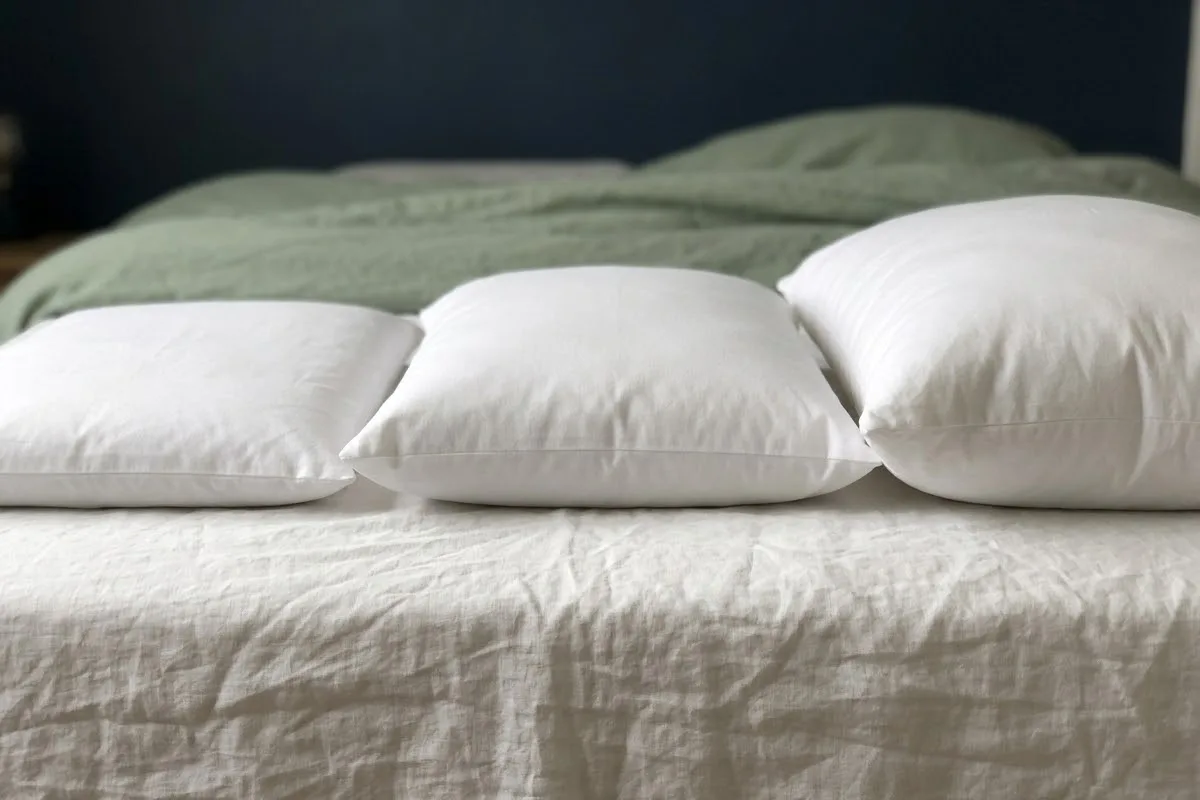
Your mattress changes the answer
A soft mattress lets your shoulder and hips sink, which shrinks the gap. Consumer Reports puts it simply: "If you have a firmer mattress, you want a fuller pillow. If you have a softer mattress, you want a thinner pillow." Keep this in mind if you're buying a new mattress and pillow at the same time.
Your build matters too
A wide-shouldered person lying on their side has a bigger gap than a narrow-shouldered one. Two people with the same sleep position can need different heights. That's why the bands above are a starting point, not a rule. Test any pillow on your own bed.
Step 3: decide how firm it should feel
Firmness is how much the pillow pushes back. It's related to height, but it isn't the same thing: a tall pillow can be soft and squash flat, and a thin one can be firm.
The Sleep Foundation's shopping guide (updated May 22, 2023) gives a general pattern: side sleepers do well with "relatively thick pillows that support the head and neck," back sleepers with "medium-loft pillows that are somewhat firm," and stomach sleepers with "soft pillows with low loft."
Going too far either way is a common complaint. The Sleep Foundation's side sleeper guide says pillows that are "too soft" let the head sink too far, while "extra-firm pillows can lead to tension" through the neck and shoulders. Medium to medium-firm is the usual target for side sleepers.

If you can touch the pillow in a store, try the test Consumer Reports describes: "Place the pillow on a flat surface and compress it with your palm to about half of its original thickness. The more pressure you have to apply, the firmer the pillow." If you're buying online, read the seller's firmness label and the buyer reviews that mention it.
Step 4: know what's inside
The fill shapes how the pillow feels, how warm it sleeps, how it handles washing and how long it lasts. Here are the most common fills, summarized from the Sleep Foundation's types of pillows page and Consumer Reports' buying guide:
| Fill | How it feels | Watch for |
|---|---|---|
| Polyester (fiberfill) | Soft, light, cheapest | Consumer Reports says it doesn't hold its shape well |
| Memory foam | Slow, molds to your head | Can trap heat; may smell at first |
| Latex | Springier than memory foam | Usually costs more; can be tall |
| Down | Very soft and fluffy, compresses easily | Pricey; may flatten too much for side sleepers |
| Feather | Firmer than down | Quills can poke through |
| Down alternative | Airy, down-like | Wide range of firmness |
| Buckwheat hulls | Firm, heavy, shapeable | Rustles when you move |

Memory foam and latex also come in two builds: one solid block or many shredded pieces. A solid block keeps a fixed shape; shredded fill can be moved around or removed.
Step 5: pick a shape
Most pillows are plain rectangles. A second group has a sculpted surface. The Sleep Foundation describes contour pillows as having a "curved surface to cradle the head and neck," and cervical pillows as having "a raised area to support the neck's natural curvature and a dip to cradle the head," usually for back and side sleepers.
Shaped pillows have a trade-off: the height is set by the shape. You can't fluff, fold or bunch them up, and they only work if you lie on them the way they're designed. Some people like the guided feel; others find it fights them when they turn over. If you're weighing a specific shaped model, our Derila Ergo research review shows what to check before you order one: the shipped price, the return rules and the firmness complaints buyers mention.
A rectangular pillow with adjustable fill is the more forgiving choice if you don't yet know your ideal height.
Heat, noise and smell
Three things you only notice after a few nights are worth checking before you pay.
Heat. The Sleep Foundation says memory foam "traps heat" and that latex "sleeps cooler than memory foam." The Ohio State article notes that "foam materials tend to be warmer while feather and synthetic filling can have a cooler feeling." If you wake up warm, put breathability near the top of your list. Cooling claims on labels vary a lot.
Noise. Buckwheat hulls rustle when you move. That's fine for some sleepers and a dealbreaker for light sleepers.
Smell. New foam can have an odor at first. The Sleep Foundation lists off-gassing odors among memory foam's downsides. If a smell would bother you, check whether the seller says anything about airing the pillow out. If you've already bought one, our guide to a memory foam pillow that's too firm covers how long the smell usually lasts.

Size and the pillowcase you already own
Size is about your bed and your pillowcases, not comfort. The Sleep Foundation lists these common dimensions:
| Size | Dimensions |
|---|---|
| Standard | 20 x 26 inches |
| Super standard | 20 x 28 inches |
| Queen | 20 x 30 inches |
| King | 20 x 36 inches |
| Euro | 26 x 26 inches |
Most people do fine with a standard size. Before you order a queen or king, check that your pillowcases fit it, or you'll be buying new ones too. Shaped pillows often use their own case size, so look for the seller's measurements.

Labels worth reading, and one to ignore
CertiPUR-US. On foam pillows you'll often see this mark. According to CertiPUR-US, certified foam is "made without" certain harmful substances and is tested for "content, emissions and durability" by independent labs. It tells you about the foam's content. It says nothing about comfort or fit.
"Hypoallergenic." Be careful with this one. Consumer Reports warns: "There are no federal standards for the term 'hypoallergenic.'" Treat it as marketing unless the seller explains what it means.
Fill and care labels. Look for the full fill list and whether the core is washable or spot-clean only. Many foam cores can't go in the washer, even when the cover can.
Price, trials and return rules
Pillow prices range widely. The Sleep Foundation's shopping guide says prices run "from as little as $10 to more than $1,000," and notes that many good options cost "less than $200." A higher price usually buys a different material or a longer trial, not a guaranteed fit.
Because fit is personal, the return rules may matter more than the price. Consumer Reports advises checking the return policy before you buy, and its examples range from a 60-day window to a 100-night sleep trial. Before you pay, check:
- How many days or nights you get, and when the clock starts.
- Whether an opened or used pillow can come back, or only a sealed one.
- Who pays return shipping.
- Whether the refund is money back or store credit.

Pillows shipped compressed in a vacuum bag are a special case. Some sellers only accept returns in the original packaging, which you can't restore once opened. Read that line before you cut the plastic.
How long a pillow should last
Lifespan depends on the fill. The Sleep Foundation's replacement guide (updated May 22, 2023) gives these ranges:
| Fill | Typical lifespan |
|---|---|
| Polyester and down alternative | 1 to 2 years |
| Down and feather | 1 to 3 years |
| Memory foam and polyfoam | 2 to 3 years |
| Latex | 2 to 4 years |
The same guide lists the signs it's time for a new one: sagging, lumps, heavy yellowing, or a pillow that "doesn't spring back to its normal shape after you fold it in half" (a test meant for down and feather). A cheaper pillow you replace every year can cost about as much over time as a pricier one that lasts three.
A five-minute checklist before you buy
- Position: side, back, stomach or a mix. Notice your position for a few mornings instead of guessing.
- Height: low, medium or high, adjusted for your shoulders and your mattress.
- Firmness: medium to medium-firm for most side sleepers, softer and thinner for stomach sleepers.
- Fill: pick for feel, heat and washing, and note the expected lifespan.
- Return rules: days, sealed or opened, who pays shipping, refund or credit.
If two pillows tie on all five, pick the one that's easier to return.
Common mistakes
- Buying by brand or ad instead of by position. A pillow praised by a stomach sleeper tells a side sleeper little.
- Ignoring the mattress. A new soft mattress can make your old pillow feel too tall.
- Trusting "hypoallergenic" or "ergonomic" as if they were standards. Check what they mean for that specific pillow.
- Choosing a fixed-height pillow when you switch positions all night. Adjustable fill forgives more.
- Opening a vacuum-packed pillow before reading the return rule. That can turn a refundable pillow into a final sale.
- Paying more for a long trial you won't use. Compare what the trial actually lets you return.
Key takeaways
- Sleep position comes first; it sets the height you need.
- Medium loft is 3 to 5 inches, per the Sleep Foundation. Side sleepers usually go higher, stomach sleepers lower.
- Firmness and height are separate choices. Medium to medium-firm suits most side sleepers.
- The fill sets the feel, warmth, noise and lifespan.
- Shaped pillows fix the height for you; that's a plus only if the height is right.
- Read the return rules before you pay, and before you open a compressed pillow.
General information, not medical advice. Comfort varies from person to person; if you have ongoing pain, numbness or breathing problems during sleep, talk to a doctor.
Frequently asked questions
How do I know which pillow is right for me?
Start with the position you wake up in most mornings, then match the height: high for side sleeping, medium for back sleeping, low for stomach sleeping, adjustable if you switch. Adjust for broad shoulders and for how soft your mattress is. After that, pick a fill you like and a store whose return rules you can live with.
Is a thicker pillow better?
Not by default. Thicker suits side sleepers, whose shoulder creates a wider gap, and the Sleep Foundation suggests at least 4 inches for most of them. Back sleepers usually do better with a medium pillow, and stomach sleepers with a thin one or none at all.
Should my shoulders be on the pillow?
For side and back sleeping, the pillow is meant to hold up your head and neck, with your shoulder on the mattress below it. If your shoulder is on the pillow, the pillow is usually too far down or too big for you.
Should a pillow be soft or firm?
It depends on position. The Sleep Foundation pairs side sleepers with thicker supportive pillows, back sleepers with "somewhat firm" medium-loft pillows, and stomach sleepers with soft, low pillows. Very soft and extra-firm both draw complaints from side sleepers.
What is the best pillow fill?
There's no single best fill, only trade-offs. Memory foam molds slowly but can run warm. Latex is springier and usually costs more. Down is soft and squashy. Polyester is the cheapest but flattens sooner. Buckwheat is firm and shapeable but rustles.
How much should I spend on a pillow?
The Sleep Foundation says prices run from about $10 to over $1,000 and that many good options cost less than $200. Compare the expected lifespan of the fill and the return rules, not only the sticker price.
Can I return a pillow after sleeping on it?
Sometimes. Some stores offer sleep trials that accept used pillows; others take back only unopened items, especially vacuum-packed ones. Read the return policy for the exact store before you buy, and keep a screenshot of it.
Is it OK to sleep without a pillow?
For stomach sleepers, the Sleep Foundation lists "a very thin pillow or no pillow at all" as an option. For side and back sleepers, the Sleep Foundation's advice is a pillow that fills the space between the head and the mattress, so skipping a pillow isn't the usual advice.
Sources we checked
All pages opened on October 8, 2026.
- Sleep Foundation, "What Is the Best Sleeping Position?", updated July 25, 2025: share of side sleepers and pillow advice by position.
- Sleep Foundation, "Pillow Research Methodology", updated September 9, 2022: loft bands in inches.
- Sleep Foundation, "How to Shop for Pillows", updated May 22, 2023: firmness by position, fill pros and cons, sizes, price range.
- Sleep Foundation, "Best Pillows for Side Sleepers", updated July 29, 2026: loft of at least 4 inches, over 6 inches for broad shoulders, firmness range.
- Sleep Foundation, "Types of Pillows", updated May 22, 2023: fill types and pillow shapes.
- Sleep Foundation, "How Often Should You Replace Your Pillows?", updated May 22, 2023: lifespan by fill and the fold test.
- Consumer Reports, "Pillow Buying Guide", updated January 13, 2026: mattress firmness, squeeze test, "hypoallergenic" warning, return policies.
- Ohio State Health & Discovery, "How to choose a pillow", by Sean Wilging, DPT, November 22, 2024: guidance by position and warmth of foam.
- CertiPUR-US, "About": what the foam certification covers.
About this guide
Written by the RestSage Team and last checked on October 8, 2026. This is a research guide: we did not test the pillows or fills described, and every number comes from the sources listed above, with the date we read them. No brand paid for or reviewed this page. Read how we work in our editorial policy, and tell us through the contact page if you spot an error.